
67% ▼ 10 points since April
For consulting firms
See where your consultants’ time goes.
We run your finance function. You get strategic insights. For US management, strategy, and advisory consulting firms, a dedicated team runs bookkeeping, payroll, accounts payable, and accounts receivable with Delphi AI under their oversight. Once a month, Visory Insights shows utilization, realization, and margin by engagement, and the one move to make.
- Every engagement invoiced on its own terms, whether retainer, fixed fee, or time and materials, with unbilled time read from your timesheets at each month-end.
- A named Payroll Specialist runs every pay run, checked by Delphi AI before you approve it, with each consultant paid as exempt or nonexempt as you set it, and withholding and filings prepared from the same run.
- Utilization by consultant and engagement every month, briefed by your Business Performance Partner in plain English, with one move to make.


Who this is for
Built for firms that sell expertise by the hour and the engagement.
If your fees come from engagements, your capacity comes from consultants and associates, and your leadership team still prices the work, this is the finance function for it.
- Management, strategy, and advisory firms and boutique consultancies of roughly $750k to $20m in revenue, led by a CEO, president, or founder.
- Fees from retainers, fixed-fee engagements, and time and materials, with rates set consultant by consultant.
- A core team of salaried consultants, with independent associates brought in as engagements land.
- Time kept in a timesheet or engagement tool, with consultants who travel to customer sites and claim the costs back.
Anywhere in the United States. Your books stay in your own QuickBooks or Xero file, which you own, and your dedicated team works inside it.
The pressure
Four federal rules decide what a consultant really costs.
A consulting firm runs on salaried consultants, associates it does not employ, and travel it bills back. Federal tax law and federal wage law each draw their own lines on who is an employee, who is owed overtime, what is reported for associates, and when an expense reimbursement becomes pay.
The long-standing associate is the one to watch.
A senior associate embedded in one customer’s team for a year, working to your direction, is a different case from a specialist booked for a single engagement. The books show who you rely on, how often, and for how long.
Set by IRS common-law rules; Fair Labor Standards Act, 29 CFR part 795
For federal employment taxes, the IRS looks at behavioral control, financial control, and the type of relationship, and you may be liable for employment taxes on a worker you treated as a contractor without a reasonable basis. Under the Fair Labor Standards Act, the test is economic reality: whether the worker depends on your business for work or is in business for themself. The 2024 rule setting out that test remains in effect for private lawsuits, the Wage and Hour Division has enforced under its 2008 Fact Sheet #13 since May 1, 2025, and the Department of Labor proposed on February 27, 2026 to replace the rule.
Internal Revenue Service, Independent contractor (self-employed) or employee?; 29 CFR part 795, effective March 11, 2024; Wage and Hour Division, Field Assistance Bulletin 2025-1, May 1, 2025; proposed rule, 91 FR 9932, February 27, 2026.Sources IRS: contractor or employee DOL: Field Assistance Bulletin 2025-1 Federal Register: 91 FR 9932
A job title and a salary do not make a consultant exempt.
Your Payroll Specialist records each role as exempt or nonexempt as you set it, and hours over 40 for nonexempt staff are paid at time and one-half in the same run.
Set by Fair Labor Standards Act; 29 CFR 541.200, 541.201, and 541.601
Unless exempt, an employee covered by the Fair Labor Standards Act is paid at least time and one-half for hours over 40 in a workweek. The administrative exemption needs a salary of at least $684 a week and a primary duty of office work directly related to the management or general business operations of the employer or its customers, including the exercise of discretion and independent judgment on matters of significance. The regulations give advisers or consultants to an employer’s customers as an example of employees who may qualify. An employee paid at least $107,432 a year in total, including at least $684 a week on a salary or fee basis, is exempt if they customarily and regularly perform at least one exempt duty.
Fair Labor Standards Act, section 7(a); 29 CFR 541.200 to 541.202 (administrative employees); 29 CFR 541.600 (amount of salary required) and 541.601 (highly compensated employees), as amended by 91 FR 27835 and 27836, May 15, 2026.Sources DOL: Overtime pay eCFR: 29 CFR 541.200 eCFR: 29 CFR 541.201 eCFR: 29 CFR 541.601
Every associate payment counts toward a January form.
Associate bills are coded to the person or company you contracted with as they are paid, so each year-end total is already in the ledger when the forms are due.
Set by Form 1099-NEC; Public Law 119-21
For tax years beginning after 2025, a business files Form 1099-NEC for each person it paid at least $2,000 during the year for services by someone who is not its employee, with the threshold open to inflation adjustment from 2027. The form goes to the associate and to the IRS by January 31. Payments to a corporation are generally not reported. An associate who has not given you a correct taxpayer identification number is subject to backup withholding at 24%.
Internal Revenue Service, Instructions for Forms 1099-MISC and 1099-NEC (Rev. December 2026), threshold raised by Public Law 119-21 for tax years beginning after 2025; Internal Revenue Code section 6071(c); Internal Revenue Service, Backup withholding.Sources IRS: Instructions for Forms 1099-MISC and 1099-NEC IRS: Backup withholding
A receipt that never arrives turns a reimbursement into pay.
Expense claims are captured with their receipts and coded to the engagement they served, so costs you bill back reach an invoice and a claim with no receipt is queried before it is reimbursed.
Set by Internal Revenue Code section 62(c); 26 CFR 1.62-2
Reimbursements paid under an accountable plan are not wages and are not subject to income tax withholding or social security, Medicare, and FUTA taxes. To be accountable, a plan requires the employee to have incurred the expense while working for you, to substantiate it within a reasonable period, and to return any excess; for travel away from home, that means the amount, time, place, and business purpose of each expense. Substantiating within 60 days and returning any excess within 120 days of the expense is generally reasonable. An amount not substantiated or returned in time is treated as paid under a nonaccountable plan and is subject to those taxes for the first payroll period after the reasonable period ends.
Internal Revenue Code section 62(c); 26 CFR 1.62-2, Reimbursements and other expense allowance arrangements, paragraphs (c), (e), (g), and (h); Internal Revenue Service, Publication 15 (2026), Employer’s Tax Guide, section 5, Accountable plan.Every instrument named here is listed with its effective date at the foot of this page.
What the leadership team sees each month
Four numbers that say whether the time is paying.
Fees, July to September $1.44m Within 3% of plan By engagement and by customer
Billable utilization 67% ▼ below the 75% target Billable hours against hours available
Realization 93% Above the 90% target Fees billed against time at standard rates
DSO 41 days Within the 45-day target Average time from invoice to cash
Which of your associates has quietly become part of the team? Start with a discovery call. A senior member of the Visory team then runs the free financial health check on your own numbers, before anything is agreed.
Book a discovery callWhat we run for consulting firms
From accurate processing to leadership confidence.
Visory Insights leads. The basics underneath it make it trustworthy and free your team for the work that matters, run by a dedicated team with Delphi AI under their oversight.Flat monthly fee. No hourly billing.
- 1 Accurate processing Bookkeeping and payroll done right, every month.
- 2 Clean, reliable data The foundation that makes reporting defensible.
- 3 Meaningful insights Cash, margin, and the year ahead, explained.
- 4 Leadership confidence You present numbers you trust. The plan gets backed.
The leading service
Visory Insights
Utilization, realization, unbilled time, and margin by engagement, explained once a month with one move to make. A named partner who walks your leadership team through utilization before the next hire, the next associate, or the next proposal is priced.
See how Visory Insights works- Monthly plain-English report
- Structured session with your leadership team
- Twelve-month forward view of cash
- A named Business Performance Partner
The basics underneath it
Bookkeeping
Fees and costs coded by customer and engagement, retainers billed in advance held until the work is done, and travel you bill back tracked to an invoice.
Explore bookkeepingPayroll
Consultants paid on schedule as exempt or nonexempt as you set it, bonuses through the run, and withholding and filings prepared from the same run.
See how payroll runsAccounts payable
Associate bills and expense claims captured, coded to the engagement they served, and paid when you approve.
See accounts payableAccounts receivable
Retainer, milestone, and time-and-materials invoices raised on the schedule you set, and followed up in your name.
See accounts receivableWorker status and tax positions stay with your advisors. Visory keeps the records those calls rest on: who you engaged, for how long, what you paid them, and what each expense claim was for. It does not decide whether an associate is an employee, whether a role is exempt from overtime, whether your expense arrangement is an accountable plan, or how an engagement’s revenue is recognized.
Visory Insights for consulting firms
One month of Visory Insights on a consulting firm’s numbers.
Reports tell you what happened. Visory Insights tells you what it means, and what to do about it. Here is September for Corvane & Lisle, a fictional management consulting firm with about $6m a year in fees and 32 people.
Realization held at 93%, so the work that reaches an invoice is billed at its rate. Less of the team’s time is billable. Eight points under target on 3,600 available hours is 288 hours, about $55k of fees in September.
Non-billable hours 1,188 hrs At Risk 288 hours past the 900 the firm plans for internal work, training, and business development, most of them from two consultants who rolled off an engagement in August with nothing to start
Billable utilization Starting the two consultants on the signed second phase, 126 hours each, takes billable hours from 2,412 to 2,664 of 3,600
Start the two consultants on the customer’s signed second phase this month, and hold the next hire until utilization is back at target. The unassigned hours are set out consultant by consultant from your timesheets, ready for your decision at the session.
≈ $48k a month billed, +7 points Insight session Accepted 9:00 to 9:45am · Video call  With your Business Performance Partner
Prepared and checked by Delphi AI, and briefed by your Business Performance Partner in plain English, ahead of your next session.
- Monthly plain-English report
- Structured insight sessions
- Utilization and realization by consultant and engagement
How much of your team’s time was billable last month? A discovery call is a conversation about how you price engagements, who does the work, and the numbers you want in front of you each month.
Book a discovery callFits your stack
Works with the tools you already use.
Your ledger and your payroll stay where they are. Visory connects to them and keeps the data flowing every day, so your team and Delphi are working from current numbers.
Accounting and books
Where your ledger and reporting live.


Payroll and people
Pay runs, payroll tax withholding and filings, and the people behind them.


Timesheets and engagement tools
Time, engagements, and budgets stay in the timesheet or engagement tool your team already runs, whether Harvest or another. Visory works from its billed and unbilled time at each month-end.
Resources for consulting firms
Content written for consulting firms by the expert teams at Visory.


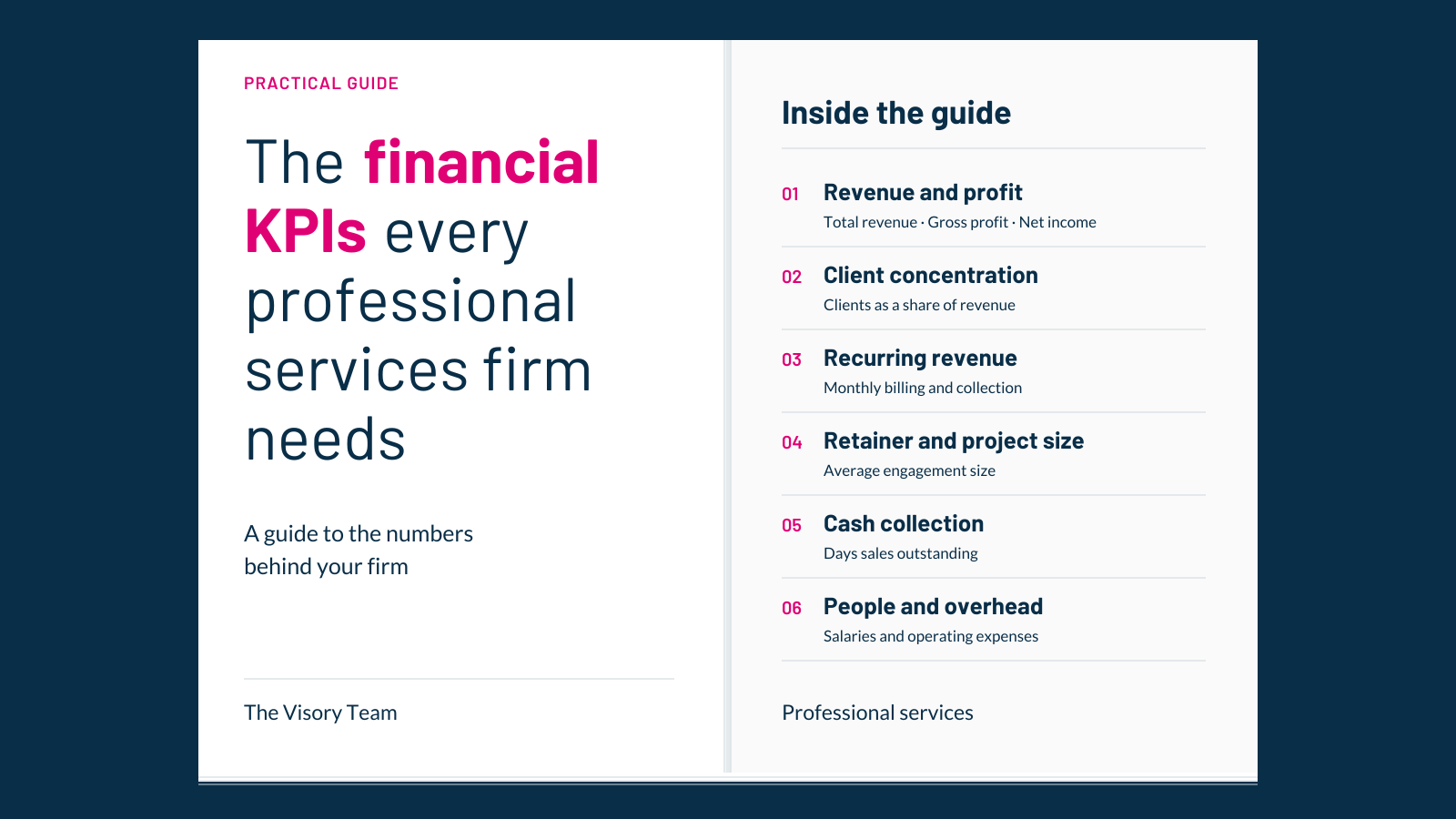
Common questions
Straight answers for consulting firms.
The questions consulting firm CEOs, presidents, and founders ask before they hand Visory the finance function. The general ones are on the common questions page.
What is the difference between utilization and realization?
Utilization is the share of a consultant’s available hours that is billable. Realization is the share of that billable time, at standard rates, that reaches an invoice. A firm can bill well and still lose margin when utilization falls, and it can be busy and still lose margin when realization falls. Visory reports both each month, by consultant and by engagement, from your timesheets and the ledger.
How do you account for retainers billed in advance?
A retainer invoiced before the work is done is held on the balance sheet as deferred revenue, and moves into fees as the work is delivered. Under US GAAP, an amount a customer has paid, or that is due, before the work is performed is presented as a contract liability (FASB ASC 606-10-45-2). It stops a quarterly retainer billed in July from making July look like your best month. This is general information, not accounting advice.
How do fixed-fee engagements show up in the monthly numbers?
Where an engagement meets the criteria for revenue over time, for example because the customer receives the benefit as your team performs, its fee is recognized as the work progresses (FASB ASC 606-10-25-27), so a project half done shows about half its fee, whatever has been invoiced. Work done ahead of billing is a contract asset, and billing ahead of the work is a contract liability. Budget against actual hours is reported each month, so an overrun shows while there is still time to agree a change order. Whether revenue is recognized over time is a judgment for your advisors. This is general information, not accounting advice.
Which associates need a Form 1099-NEC?
For tax years beginning after 2025, a business files Form 1099-NEC for each person it paid at least $2,000 during the year for services by someone who is not its employee, and the form goes to the associate and to the IRS by January 31. Payments to a corporation are generally not reported. An associate who has not given you a correct taxpayer identification number is subject to backup withholding at 24%. Visory codes associate payments to the person or company you contracted with as they are paid, so each total is in the ledger at year-end. This is general information, not tax advice.
Is our long-term associate actually an employee?
It may be. For federal employment taxes, the IRS looks at who controls how the work is done, who controls the business side of it, and how the relationship is set up. Under federal wage law, the question is whether the person depends on your firm for work or is in business for themself. That call is yours, with your legal advisors. Visory shows how long each associate has worked with you, how often, and at what cost, which is usually where the question starts. This is general information, not legal advice.
Are our salaried consultants owed overtime?
Not if the exemption fits. Under the Fair Labor Standards Act, an employee who is not exempt is paid at least time and one-half for hours over 40 in a workweek. A consultant can be exempt as an administrative employee when paid a salary of at least $684 a week and their primary duty is office work directly related to running the business of your firm or its customers, with discretion and independent judgment on matters of significance; an employee who simply tabulates data is not exempt. An employee paid at least $107,432 a year in total who regularly performs at least one exempt duty is exempt under a shorter test. Your Payroll Specialist records each role’s status as you set it, and Delphi AI checks every run against it. This is general information, not legal advice.
Are our consultants’ travel reimbursements taxable?
Not under an accountable plan. Reimbursements are not wages when the employee incurred the expense while working for you, substantiates it within a reasonable period, and returns any excess. Substantiating within 60 days and returning any excess within 120 days is generally reasonable, and for travel away from home the amount, time, place, and business purpose of each expense are recorded. An amount not substantiated or returned in time is taxed as wages. Visory captures each claim with its receipt and codes it to the engagement, so costs you bill back reach an invoice. This is general information, not tax advice.
Will you raise and follow up our customer invoices?
Yes, in your name. Retainers go out on their schedule, time-and-materials invoices from approved timesheets, and fixed-fee invoices at each milestone you sign off. Overdue invoices are followed up on a cadence you agree, and days sales outstanding (DSO) is reported by customer each month, so a slow payer is raised before the next engagement with them starts.
How much does Visory cost?
Visory charges one flat monthly fee for the scope we agree. No timesheets, no hourly billing, no surprises. The fee reflects the services you take and the volume of work in your firm, from the size of the pay run to the number of customer invoices and associate bills each month, so you know the monthly cost before you start.
See how pricing works More questions, longer answers. Every question has its own link. See all common questions
General information for consulting firms, not financial or tax advice.
Getting started
Start with clarity, not a contract.
Three steps, in whatever rhythm suits you. Each one is useful on its own.
-

Book a discovery call
An obligation-free conversation about how you price engagements, how you use associates, and what you want the numbers to show.
Obligation-free -

Get your free financial health check
A senior member of the Visory team analyzes your financials and shows where your finance function can improve. See the clarity before you commit to anything.
Free · your own numbers -
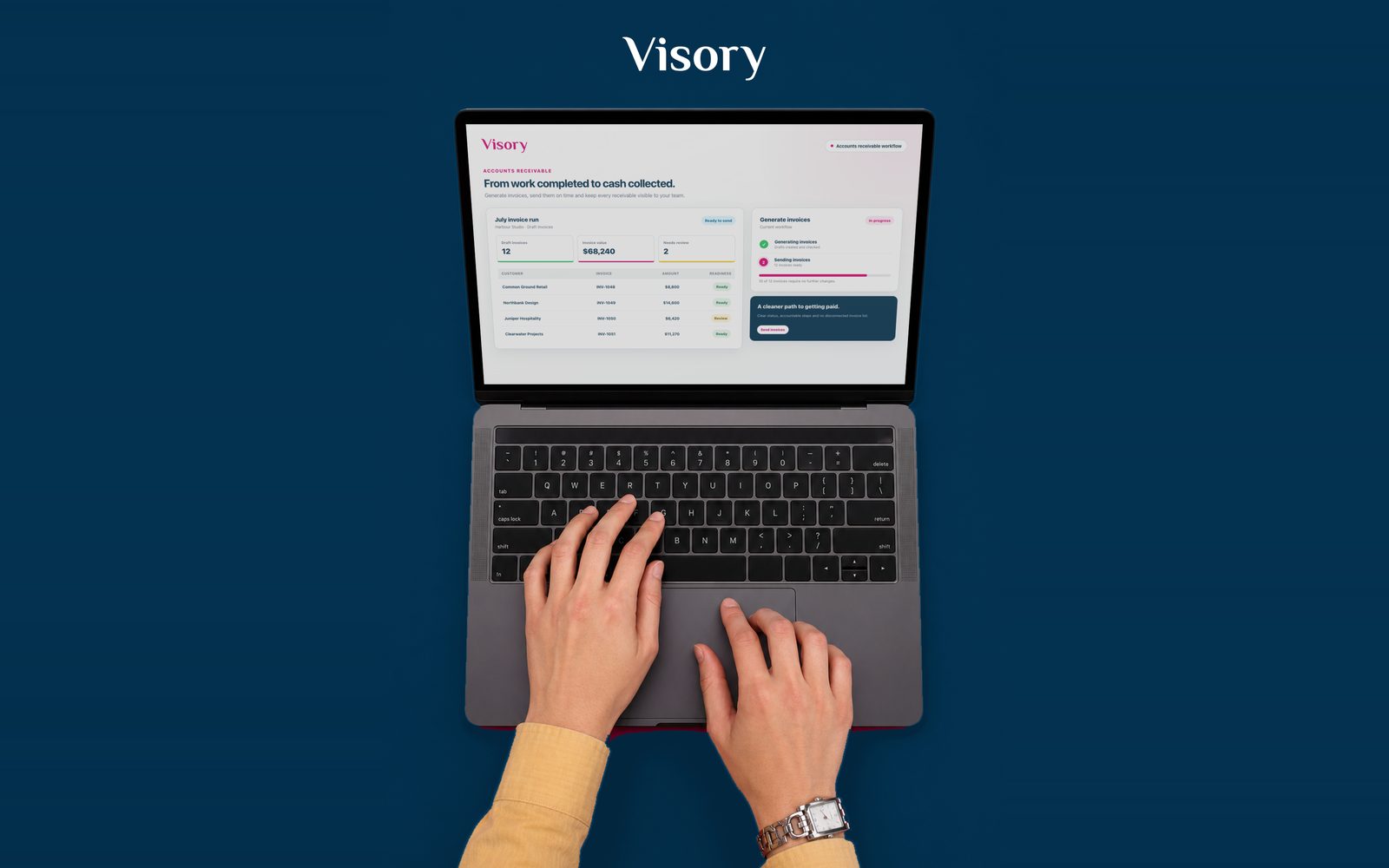
See how Visory works in practice
A walkthrough of the books, the pay run, and the monthly read for a consulting firm like yours. If it fits, we agree a flat monthly scope.
Flat monthly fee
Get started
Make the next hire knowing where this month’s hours went.
Start with a discovery call. Then a senior member of the Visory team runs the free financial health check on your own numbers and shows you where your consultants’ time stops short of an invoice.
Sources (6) · rules last checked October 8, 2026
- Internal Revenue Service, Independent contractor (self-employed) or employee?: behavioral control, financial control, and type of relationship, page reviewed May 19, 2026.
- 29 CFR part 795, Employee or Independent Contractor Classification Under the Fair Labor Standards Act (89 FR 1638), effective March 11, 2024; U.S. Department of Labor, Wage and Hour Division, Field Assistance Bulletin 2025-1, issued May 1, 2025; proposed rule, Employee or Independent Contractor Status Under the Fair Labor Standards Act, 91 FR 9932, published February 27, 2026.
- Internal Revenue Service, Instructions for Forms 1099-MISC and 1099-NEC (Rev. December 2026): $2,000 threshold for tax years beginning after 2025 under Public Law 119-21, filing and furnishing by January 31 under Internal Revenue Code section 6071(c); Internal Revenue Service, Backup withholding, at 24%, page reviewed June 28, 2026.
- Fair Labor Standards Act, section 7(a): overtime at not less than time and one-half for hours over 40 in a workweek; 29 CFR 541.200, the administrative exemption; 29 CFR 541.201(c), advisers or consultants to an employer’s customers; 29 CFR 541.202, discretion and independent judgment, including 541.202(e) on tabulating data; 29 CFR 541.600, salary of not less than $684 a week, as amended by 91 FR 27835, and 29 CFR 541.601, total annual compensation of at least $107,432, as amended by 91 FR 27836, both effective May 15, 2026 (final rule at 91 FR 27833).
- Internal Revenue Code section 62(c); 26 CFR 1.62-2, Reimbursements and other expense allowance arrangements, paragraphs (c)(4) and (c)(5) (treatment of payments), (e) (substantiation), (g)(2) (the 60-day and 120-day safe harbors), and (h) (withholding), last amended July 26, 2016; Internal Revenue Service, Publication 15 (2026), Employer’s Tax Guide, section 5, Accountable plan, page reviewed April 30, 2026.
- Financial Accounting Standards Board, Accounting Standards Codification 606-10-25-27 (performance obligations satisfied over time) and 606-10-45-1 through 45-3 (contract liabilities and contract assets), added by Accounting Standards Update 2014-09, Revenue from Contracts with Customers (Topic 606), issued May 2014.